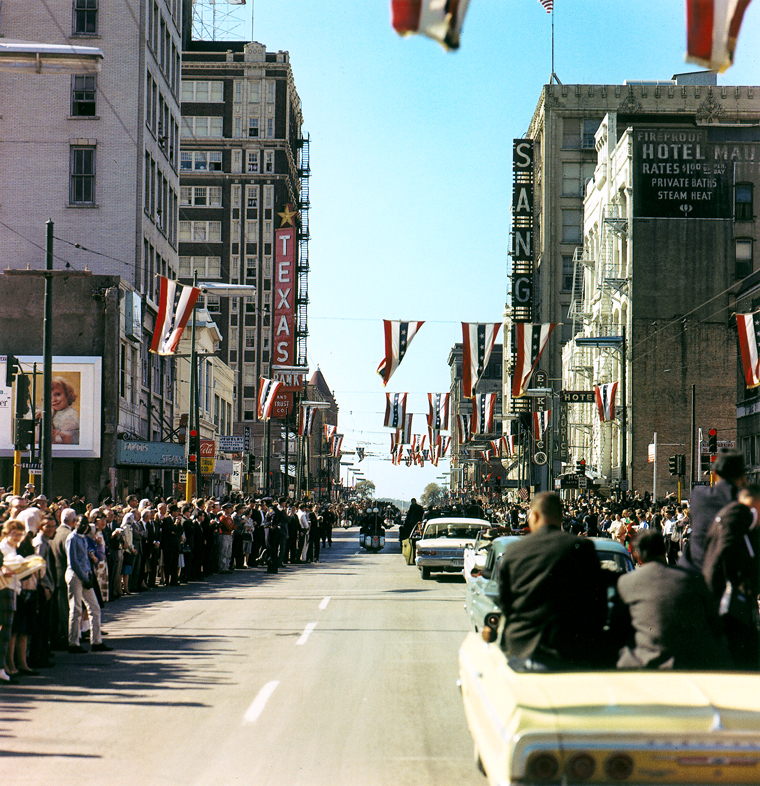
Arrival at Love Field
President Kennedy, Jacqueline Kennedy and the presidential party arrive in Dallas from Fort Worth. Crowds greet them before the motorcade forms at the airport.
Dallas · 22 November 1963 · the events, places and people
Explore the final Dallas motorcade, Dealey Plaza, the shooting of President Kennedy, the immediate aftermath, Lee Harvey Oswald, Jack Ruby and the investigations that followed. Use the illustrated route, concise event summaries and searchable 1,932-record chronology to move from the story of the day into the detailed historical record.
The story
On Friday 22 November 1963, President John F. Kennedy travelled through Dallas in an open presidential limousine as part of a political visit to Texas. The motorcade was heading toward a luncheon at the Trade Mart when it entered Dealey Plaza shortly after 12:30 p.m.
Shots struck President Kennedy and Texas Governor John Connally as the limousine travelled along Elm Street. Kennedy was rushed to Parkland Memorial Hospital, where he was pronounced dead at 1:00 p.m. The events that followed — the killing of police officer J. D. Tippit, the arrest of Lee Harvey Oswald and Oswald's shooting by Jack Ruby — became part of one of the most intensely examined episodes in modern American history.
This site combines an illustrated account of the places and events with a searchable chronology. Visitors can follow the motorcade route and key moments first, then explore the underlying records by year, person, event or place.
22 November 1963
These summaries provide orientation before the detailed database. They follow the basic chronology in the Warren Commission narrative and are deliberately concise; the searchable archive below preserves much more detailed material and competing historical claims.
President Kennedy, Jacqueline Kennedy and the presidential party arrive in Dallas from Fort Worth. Crowds greet them before the motorcade forms at the airport.
The procession leaves Love Field and follows the published route through residential areas and downtown Dallas toward a scheduled luncheon at the Trade Mart.
The limousine turns from Main Street onto Houston and then Elm Street. Shots are fired as the motorcade passes the Texas School Book Depository; Kennedy and Governor John Connally are wounded.
The presidential limousine is rushed to Parkland. Doctors attempt emergency treatment, but President Kennedy is pronounced dead at 1:00 p.m.; Governor Connally undergoes treatment and survives.
Dallas police officer J. D. Tippit is shot in Oak Cliff at about 1:15–1:16 p.m. Lee Harvey Oswald is later arrested at the Texas Theatre and becomes the principal suspect in both killings.
While police are transferring Oswald, Dallas nightclub owner Jack Ruby shoots him in the police basement. Oswald dies later at Parkland Hospital, intensifying public controversy and later investigations.
Why questions persisted
The Warren Commission concluded in 1964 that Lee Harvey Oswald fired the shots that killed President Kennedy and that it found no credible evidence that Oswald or Jack Ruby was part of a conspiracy. Doubts nevertheless developed quickly, partly because the assassination unfolded amid confusion, incomplete information and events that prevented a normal criminal trial.
Jack Ruby shot Oswald two days after the assassination, before prosecutors could test the evidence in a public trial. That left many questions to be answered through investigations rather than adversarial courtroom examination.
The Commission concluded that one bullet passed through President Kennedy and then caused several of Governor John Connally's wounds. The timing of the shots made this conclusion important, and critics soon focused on the bullet's path, condition and the sequence of the wounds.
Witnesses differed over the number, spacing and apparent direction of the shots. Some believed sound came from the grassy-knoll area, while other evidence pointed toward the Texas School Book Depository. Echoes between buildings and the underpass complicated immediate impressions.
Police, journalists and witnesses released information rapidly during the first days. The Warren Commission later noted that inaccurate reports, corrections and evidence published out of context produced misleading reconstructions and helped rumours take hold.
Ruby's ability to enter the Dallas police basement and shoot Oswald on live television immediately prompted suspicion that Oswald had been deliberately silenced. The Commission investigated Ruby's background and associations and reported that it found no evidence that Ruby and Oswald were conspirators.
Later congressional review found that the Warren Commission did not receive all relevant information held by federal agencies. The House Select Committee on Assassinations said the Commission investigated Oswald's responsibility thoroughly but investigated the possibility of conspiracy inadequately.
Early conspiracy theories
These theories became part of the public history of the case. Their inclusion here describes what was alleged or suspected; it does not mean the allegations were established by evidence.
Some witnesses believed one or more shots came from the grassy knoll. This became the most enduring alternative to the Commission's conclusion that the shots were fired from the Depository.
Oswald's earlier defection to the Soviet Union, pro-Castro activity and 1963 trip to Mexico City generated theories involving either Soviet or Cuban direction. The Warren Commission said it found no evidence that a foreign government employed or encouraged him to assassinate Kennedy.
Because Kennedy-era policy included covert operations against Cuba, critics examined Oswald's contacts in New Orleans and the activities of anti-Castro groups. Later revelations about secret intelligence programs intensified suspicion, but they did not by themselves establish involvement in the assassination.
Ruby's nightclub background and contacts in Dallas led some writers to suggest organised-crime involvement. The Commission examined Ruby's associations and reported that it found no evidence connecting him to a conspiracy to kill Kennedy.
Ruby's shooting of Oswald created an immediate theory that he had been sent to prevent Oswald from talking. The Commission rejected that interpretation, concluding that the available evidence did not demonstrate a conspiratorial relationship between the two men.
Some critics came to believe that agencies had withheld or manipulated information. Later congressional investigators did find shortcomings in inter-agency information sharing and said the Commission's conspiracy inquiry was inadequate, while also finding that the Commission reached its conclusions in good faith.
Later review: In 1979 the House Select Committee on Assassinations concluded that the Warren Commission had conducted a thorough investigation of Oswald's responsibility but had not adequately investigated possible conspiracy and had expressed its conclusions too definitively. The committee itself concluded that Kennedy was probably killed as a result of a conspiracy, a finding substantially tied to acoustic evidence that became controversial in subsequent analysis.
Dealey Plaza · Dallas
Dealey Plaza is a compact urban landscape at the western edge of downtown Dallas. Elm, Main and Commerce Streets run west toward the triple underpass, while Houston Street crosses them on the eastern side of the plaza.
The presidential limousine travelled west on Main Street, turned right onto Houston, then made the sharp left turn onto Elm Street. The Texas School Book Depository stood immediately behind the limousine after that turn.
North of Elm Street are the grassy knoll and white concrete pergola. Abraham Zapruder filmed the assassination from the raised area beside the pergola, while the triple underpass lies at the western end of the plaza.
Dealey Plaza photograph · Elm Street, pergola and triple underpass · source and licenceDallas motorcade
Schematic route map — not to geographic scale. Street sequence is based on the published and subsequently travelled presidential motorcade route.
The National Archives records the route as Love Field → Mockingbird Lane → Lemmon Avenue → Turtle Creek Boulevard → Cedar Springs → Harwood → Main → Houston → Elm → Stemmons Freeway toward the Trade Mart. The shooting occurred on Elm Street in Dealey Plaza; the limousine then proceeded to Parkland Memorial Hospital.
Detailed Dealey Plaza map
The historic maps below show the motorcade's path through Dealey Plaza and the relationship between the principal landmarks discussed in the assassination record.
The location is unusually easy to understand once the street geometry is visible: Houston runs north-south at the eastern edge of the plaza, while Elm curves southwest from the Depository toward the underpass. The grassy knoll lies immediately north of Elm.
Annotated map sourceExplore the detailed chronology
Use the detailed records when you want to move beyond the overview. Text dropdowns are alphabetical and Year is chronological. Choose one or more filters, then select Show records.
Detailed historical records
Sort order: year → month → day → event → surname (NAME2).
People, places and investigations
The archive is designed to support detailed chronological research rather than a single narrative. Frequently represented subjects include the Dallas motorcade, Dealey Plaza, the Texas School Book Depository, Parkland Memorial Hospital, Lee Harvey Oswald, Jack Ruby, eyewitness evidence, the Warren Commission and the House Select Committee on Assassinations.
These external institutions provide authoritative primary documents, official reports and archival context for independent verification.